Cáo Studio · वियतनाम फोटोशूट गाइड · Vietnam में Ao Dai Photoshoot: Studio को कैसे चुनें #
Vietnamese Khan Dong Headpiece for Ao Dai Photoshoots: What to Wear
Cáo Studio टीम · हनोई
Brides, travelers, and cultural enthusiasts ask the same question: "Which khan dong should I buy for my ao dai photoshoot?" The answer depends on three things—your ao dai color, whether you want silk or cotton, and how your face shape looks framed in different styles.
At Cáo Studio – Makeup & Photoshoot, we've styled thousands of khan dong wraps for Hanoi, Saigon, and traveling clients. This guide shows you exactly what to look for, what works for different face shapes, and how to avoid the most common mistake: buying a khan dong that clashes with your ao dai or doesn't suit the photo location's sunlight.
Silk vs. Cotton: Which Khan Dong Fabric Suits Your Shoot?
Silk khan dong wraps are smooth, drape elegantly, and catch light beautifully in outdoor photography—essential for Hanoi's Old Quarter (हनोई का पुराना शहर) or Hoi An's lantern-lit streets. Cotton khan dong breathe better in humidity and suit temple photoshoots, where modest, matte fabrics feel more respectful. For summer shoots in Vietnam's heat, many clients ask whether silk wrinkles. It doesn't—silk breathes and falls straight. Cotton, however, absorbs sweat and can look creased after 30 minutes outdoors.
Real decision point: If you're shooting in May–September heat or doing a full-day session, cotton khan dong keeps you comfortable. If your shoot is 2–3 hours in December–February Hanoi light, silk will photograph better and feel luxurious.
Compare the two:
| Fabric | Best for | Care | Photo Appearance | Durability |
|---|---|---|---|---|
| Silk | Outdoor shoots, golden light, 1–3 hour sessions | Hand wash, air dry, store flat | Luminous, elegant drape, catches highlights | 3–5 years with care |
| Cotton | Temple visits, humid days, full-day shoots | Machine wash (cold), quick dry | Matte finish, modest, crisp folds | 5+ years, tougher |
Khan Dong Colors That Actually Work With Ao Dai
Beginner mistake: matching khan dong and ao dai in the exact same shade. Professional stylists do the opposite—they use contrast or near-harmony.
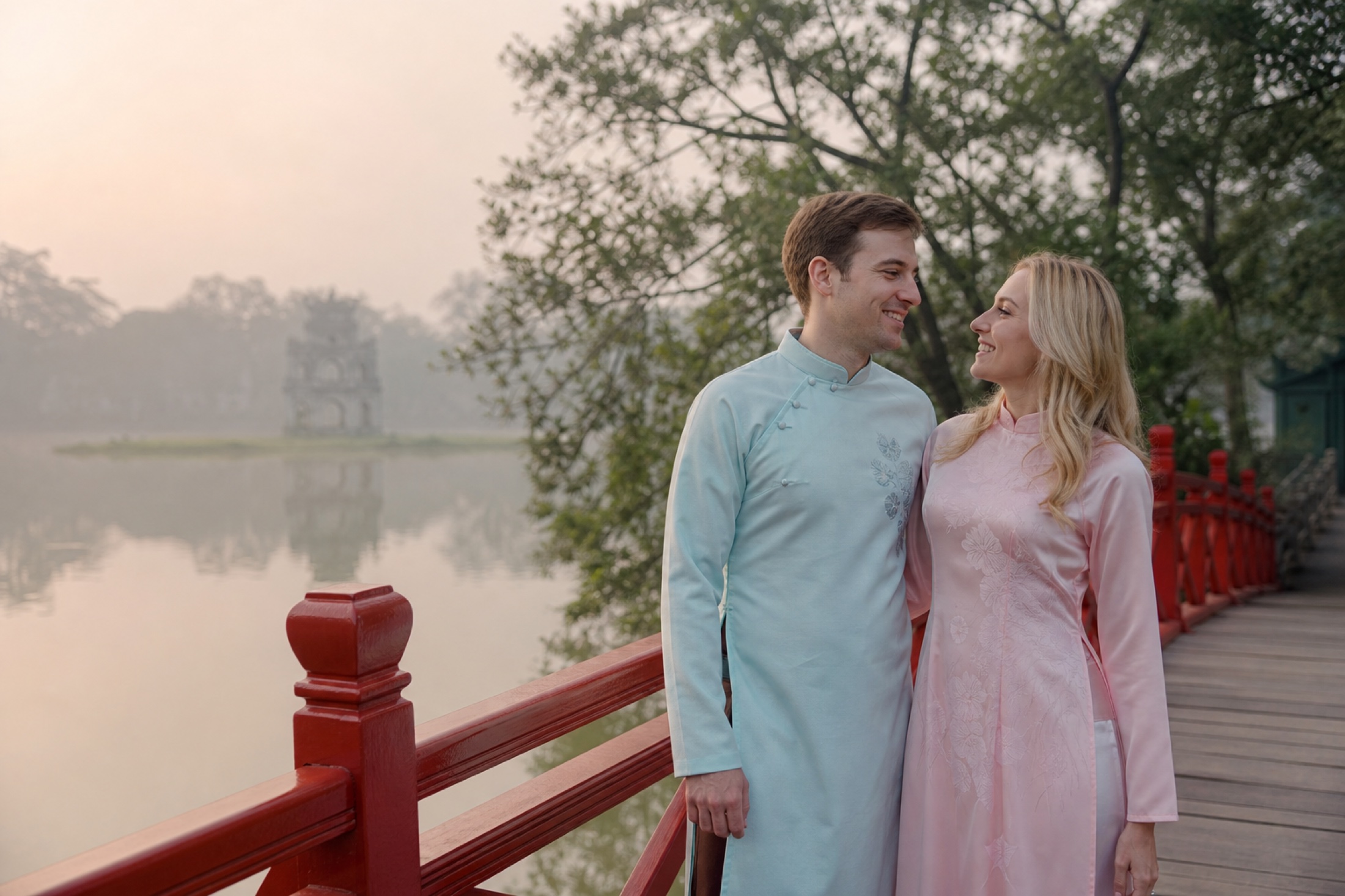
If your ao dai is red (लाल) or pink (गुलाबी), a white, cream, or gold khan dong frames your face and avoids the "solid block" look that flattens images in photos. If your ao dai is white or cream, a darker wrap—navy (नेवी नीली), sage green (ऋषि हरी), or dusty rose (धूलदार गुलाब)—adds visual interest and makes your face stand out.
The rule we follow at Cáo Studio: the khan dong should be 1–2 shades lighter or darker than your ao dai, or a complementary color from the opposite side of the color wheel. In natural Hanoi light (softer in winter, harsh in summer), this difference becomes visible and flattering.
Common question: "Can I wear a patterned khan dong?" Yes, if the ao dai is solid. If both are patterned, the eye gets confused in photos. Choose one patterned piece; keep the other plain.
Face Shape & Khan Dong Draping Styles
Your face shape determines which draping style photographs best. This is the angle most shoppers miss—they buy based on color alone, then struggle with how the wrap sits.
Round faces benefit from khan dong wrapped high on the crown and draped to one side—this elongates and adds definition. The wrap should frame the cheekbones, not hug them tightly. Ask your stylist to start the wrap at the back of the head, not the forehead.
Oval faces (considered ideal in Vietnamese tradition) work with any draping—center, left, or right. You have the most flexibility. Most clients with oval faces choose a side drape because it photographs as more romantic.
Square or angular faces suit a softer, looser wrap that covers the jawline slightly. A center drape with a soft fold across the forehead softens sharp lines.
Heart-shaped faces (wider forehead, narrower chin) work best with khan dong draped to cover the forehead slightly and sitting higher on the crown. This balances proportions.
At our Hanoi studio and Saigon studio, our stylists assess your face in person and adjust the wrap accordingly. If you're ordering online and mailing the khan dong before your session, ask the seller about adjustability—good wraps have enough fabric to accommodate different draping techniques.
📸 Book on WhatsApp — ao dai photoshoot
Khan Dong Shopping Checklist: What to Check Before You Buy
Before ordering, verify three non-negotiables:
- Fabric weight & length. A khan dong should be at least 150 cm long (60 inches) so you have fabric to drape around the head, under the chin, and across one shoulder without feeling tight. Check seller measurements—some vendors list width but not length. If a wrap is only 120 cm, it's too short for traditional draping.
- Seam finish and edges. Look at product photos closely. Edges should be rolled or sewn (not raw and unfinished), especially on silk wraps that will fray. Check if the seam is visible or hidden—visible seams photograph in close-ups. Hidden seams cost slightly more but look professional in headshots.
- Color accuracy in natural light. Don't judge color from product photos alone. Most online photos use studio lighting, which makes colors appear different than in outdoor Vietnamese sun. If possible, request a photo of the khan dong outdoors (in daylight, not studio light). If the seller can't provide one, assume it may look 10–15% different in person.
Practical tip: Order 2–3 weeks before your shoot so you have time to test the wrap at home, practice draping (watch a YouTube tutorial in your language), and contact the seller if the length doesn't work. Returns from Vietnam can take 20+ days.
Styling Khan Dong for Different Photo Locations
A khan dong draped beautifully in your bedroom may look different outdoors at a temple, on a street, or by water. Lighting and background change how the wrap photographs.
Temple shoots (Hang Luoc Temple (हांग लुओक मंदिर), Bat Trang kiln areas): Choose matte fabrics (cotton or silk cotton blend). Gold, cream, or white khan dong show respect and photograph beautifully against darker temple stones. The wrap frames your face and keeps you modest—important in sacred spaces. Morning light (6–9 AM) hits temples from the side, so a side drape works best.
Street & architecture shoots (Old Quarter alleys, Hoi An (होई आन), Hanoi's colonial villas): Silk khan dong in jewel tones (emerald, sapphire, deep rose) pop against pastel buildings. Afternoon light (2–5 PM) is harsher, so drape the wrap to shade one side of your face slightly—this adds dimension and hides harsh shadows.
Garden & flower shoots (Hoa Lang Thang partner locations): Soft, flowing cotton khan dong in pastels (blush, sage, lavender) blend beautifully with flowers. Choose a center or loose side drape. Golden light at sunrise (5–7 AM) or sunset (5–6 PM) makes any khan dong luminous.
Open-air photoshoots (lakeside, rooftop, parks): Silk khan dong catches wind beautifully and creates movement in photos. Avoid heavy cotton wraps here—they won't flow. Morning or late afternoon light is best; midday (11 AM–3 PM) creates harsh shadows under the khan dong's folds.
Our stylists at Cáo Studio adapt your khan dong drape to the location during your session—you're not locked into one style for the whole shoot.
When to Buy vs. Rent: A Traveler's Decision Framework
Deciding whether to buy or rent a khan dong depends on how many shoots you're doing and whether you want to keep the wrap after Vietnam.
| Choice | Best for | Cost Reality | Ownership |
|---|---|---|---|
| Buy (new, online) | Multiple shoots, keepsake, custom color match | Higher upfront, arrives before trip | You own it, no return rush |
| Buy (vintage/second-hand) | Budget-conscious, authentic patina, less pressure | 40–60% cheaper than new | You own it, risk of hidden wear |
| Rent (in Vietnam) | One shoot, traveling light, want expert styling | Daily rental fee + styling | Return within 2–3 days |
Most travelers ask: "Should I buy before I arrive or rent in Hanoi?" If you're doing an ao dai photoshoot with Cáo Studio, ask us about renting styled khan dong wraps—we have a curated collection in multiple colors, and our stylists adjust the drape during your session. Renting removes the worry of shipping damage and gives you expert styling included.
If you're doing multiple shoots (a couple photoshoot plus family portraits), buying makes sense economically. If it's a one-time pre-wedding session, renting is simpler.
Styling Khan Dong for Different Skin Tones
Khan dong color is partly cultural choice, partly skin-flattering science. What looks stunning on your friend may wash you out, not because the wrap is bad—because it's not your color.
Fair/light skin tones glow against warm khaki, cream, soft gold, and pale pink khan dong. Cool silk in white or silver also works. Avoid muddy browns or grayed-out pastels—they drain fair complexions.
Medium/tan skin tones are most versatile. Jewel tones (emerald, sapphire, ruby), warm golds, burnt orange, and dusty rose all photograph beautifully. Avoid very pale pastels, which can look washed out.
Deep/dark skin tones are stunning in saturated colors: deep emerald, royal blue, rich burgundy, gold, and warm rust. Cream and white khan dong also work beautifully. Skip muddy or overly muted tones.
One professional rule: if you're unsure, choose white or cream khan dong. It flatters every skin tone, photographs beautifully in any light, and is the most traditional choice for formal photoshoots.
Common Mistakes to Avoid When Buying & Wearing Khan Dong
Mistake 1: Buying a khan dong too short. Less than 140 cm, and you can't drape it properly. You'll end up tying it like a scarf instead of wrapping it, which looks casual, not ceremonial. Check length in centimeters, not just "one size fits all."
Mistake 2: Choosing a wrap the exact same color as your ao dai. This creates a "column" effect in photos—your body looks flat and blocky. Contrast or near-harmony is always better. Test by taking a selfie with both pieces together before ordering.
Mistake 3: Not checking seam finish. Raw, unfinished edges fray in photos and look cheap in close-ups. Spend the extra time inspecting product images. A 2-centimeter close-up of the seam edge tells you everything.
Mistake 4: Wearing the khan dong too tight. If you're uncomfortable, it shows in your face. The wrap should be snug enough to stay in place during movement but loose enough that you don't feel strangled. Our stylists teach you the right tension during your session—if you're wearing a wrap you bought yourself, practice tying it at home and do a comfort test of at least 30 minutes.
Mistake 5: Ignoring humidity. If you buy silk khan dong and your shoot is in July–August in Hanoi, humidity will make the wrap limp. Cotton or a silk-cotton blend is smarter. Ask the seller about fabric composition—pure silk versus blended fabric makes a real difference in tropical heat.
How Cáo Studio Styles Khan Dong for Your Shoot
Our approach at Cáo Studio is hands-on. When you book an ao dai photoshoot with us in Hanoi or Saigon, the styling process works like this:
- Pre-shoot consultation (on WhatsApp): We ask your ao dai color, your face shape, the location you've chosen (temple, street, garden), and your skin tone. We recommend a khan dong color and style based on your answers.
- In-studio styling (1–2 hours before shooting): Our stylist wraps your khan dong, adjusts it to flatter your face, and shows you how to sit and move without the wrap shifting. You see the result in a test photo before we start the main shoot.
- On-location adjustments (during the shoot): Light changes. Wind moves the wrap. We re-drape as needed so every shot is polished.
If you want to bring your own khan dong, we work with it—we'll adjust it to match the location and light. If you want to rent from us, we style it as part of your package. Either way, the result is professional.
---
What to Check Before You Order
- Length: Minimum 150 cm (60 inches).
- Seam finish: Rolled or sewn edges, not raw.
- Fabric weight: Heavy enough to drape, light enough to breathe in heat.
- Color accuracy: Request an outdoor photo, not just studio images.
- Return policy: Verify you can return if size or color doesn't match.
- Delivery time: Order at least 2–3 weeks before your shoot.
FAQ
Can I wear a khan dong if I have short hair?
Yes. Khan dong works with any hair length. Short hair shows off the wrap beautifully—your neck and shoulders become the frame. Our stylists wrap it the same way; the difference is you don't have long hair covering the silk. Many clients with bobs and pixie cuts look stunning in khan dong. Ask your stylist to position it slightly higher on the crown if your hair is very short.
What's the difference between khan dong and a traditional Vietnamese headwrap for brides?
Khan dong is the everyday/photoshoot wrap—elegant but not ceremonial. A traditional bridal wrap (worn at weddings) is usually heavier, more ornate, sometimes embroidered, and draped differently to cover more of the head. If you're booking a pre-wedding photoshoot or proposal session, tell us whether you want casual khan dong style or more formal bridal wrapping. We offer both.
Do I need to wash the khan dong before wearing it?
Check the seller's care instructions. Most new khan dong from Vietnam don't require pre-washing if they're silk or silk blend—the dyes are set. If it's cotton, a gentle hand wash in cool water removes excess dye and softens the fabric. Let it air dry flat. Never machine wash or tumble dry khan dong.
How do I keep the khan dong from slipping during photos?
Secure it with bobby pins at the back of your head (under the wrap, so they're not visible). Pin the wrap to your hair at the crown and behind each ear. Our stylists do this automatically during your session. If you're wearing your own khan dong, practice with pins at home. Test by moving your head side to side—if the wrap shifts, add more pins. Never rely on tightness alone; pins are invisible and professional.
Can I wear khan dong with a different outfit, not an ao dai?
Technically yes, but it will look costume-like, not authentic. Khan dong is designed to complement ao dai's neckline and drape. Wearing it with modern clothes or other traditional dress reads as a costume choice in photos. If you're doing a cultural photoshoot (not a traditional ao dai shoot) and want to include khan dong, let us know—we can style it creatively, but expect the result to be artistic rather than authentic.
How much does khan dong usually cost?
We don't publish fixed prices because khan dong ranges widely—machine-made cotton wraps start lower, hand-woven or silk pieces cost more. For photoshoot styling, ask us on WhatsApp (84 865 239 183) about rental or wearing your own. We give personalized quotes based on fabric, customization, and your shoot length.
What's the best time of year to do a khan dong photoshoot in Vietnam?
December–February (winter): cool, clear light, no glare on fabrics. March–April (spring): warm but not humid, flowers blooming. May–September (summer & monsoon): humid, midday light is harsh, but early morning/sunset shots are beautiful and golden. October–November (autumn): similar to spring. Avoid midday shoots in summer unless you're indoors or under trees. Tell us your travel dates; we'll recommend the best shooting times and suggest appropriate fabric weight.
Can I order khan dong from outside Vietnam and bring it to my shoot?
Yes, absolutely. Just order at least 3 weeks early to account for shipping. Bring it to your session in Hanoi or Saigon—our stylists will adjust it to fit your face shape and the location's light. If you're unsure about color or size when it arrives, contact us on WhatsApp to troubleshoot before your shoot date.
अक्सर पूछे जाने वाले सवाल
Can I wear a khan dong if I have short hair?
Yes. Khan dong works with any hair length. Short hair shows off the wrap beautifully—your neck and shoulders become the frame. Our stylists wrap it the same way; the difference is you don't have long hair covering the silk. Many clients with bobs and pixie cuts look stunning in khan dong. Ask your stylist to position it slightly higher on the crown if your hair is very short.
What's the difference between khan dong and a traditional Vietnamese headwrap for brides?
Khan dong is the everyday/photoshoot wrap—elegant but not ceremonial. A traditional bridal wrap (worn at weddings) is usually heavier, more ornate, sometimes embroidered, and draped differently to cover more of the head. If you're booking a pre-wedding photoshoot or proposal session, tell us whether you want casual khan dong style or more formal bridal wrapping. We offer both.
Do I need to wash the khan dong before wearing it?
Check the seller's care instructions. Most new khan dong from Vietnam don't require pre-washing if they're silk or silk blend—the dyes are set. If it's cotton, a gentle hand wash in cool water removes excess dye and softens the fabric. Let it air dry flat. Never machine wash or tumble dry khan dong.
How do I keep the khan dong from slipping during photos?
Secure it with bobby pins at the back of your head (under the wrap, so they're not visible). Pin the wrap to your hair at the crown and behind each ear. Our stylists do this automatically during your session. If you're wearing your own khan dong, practice with pins at home. Test by moving your head side to side—if the wrap shifts, add more pins. Never rely on tightness alone; pins are invisible and professional.
Can I wear khan dong with a different outfit, not an ao dai?
Technically yes, but it will look costume-like, not authentic. Khan dong is designed to complement ao dai's neckline and drape. Wearing it with modern clothes or other traditional dress reads as a costume choice in photos. If you're doing a cultural photoshoot (not a traditional ao dai shoot) and want to include khan dong, let us know—we can style it creatively, but expect the result to be artistic rather than authentic.
How much does khan dong usually cost?
We don't publish fixed prices because khan dong ranges widely—machine-made cotton wraps start lower, hand-woven or silk pieces cost more. For photoshoot styling, ask us on WhatsApp (84 865 239 183) about rental or wearing your own. We give personalized quotes based on fabric, customization, and your shoot length.
What's the best time of year to do a khan dong photoshoot in Vietnam?
December–February (winter): cool, clear light, no glare on fabrics. March–April (spring): warm but not humid, flowers blooming. May–September (summer & monsoon): humid, midday light is harsh, but early morning/sunset shots are beautiful and golden. October–November (autumn): similar to spring. Avoid midday shoots in summer unless you're indoors or under trees. Tell us your travel dates; we'll recommend the best shooting times and suggest appropriate fabric weight.
Can I order khan dong from outside Vietnam and bring it to my shoot?
Yes, absolutely. Just order at least 3 weeks early to account for shipping. Bring it to your session in Hanoi or Saigon—our stylists will adjust it to fit your face shape and the location's light. If you're unsure about color or size when it arrives, contact us on WhatsApp to troubleshoot before your shoot date.