lookbook
Hoi An Photoshoot: Studio vs. Street Sessions & What to Book
Hoi An is Vietnam's most photographed town—and with reason. Lantern-draped alleys, weathered shopfronts, and the Thu Bon River at dusk create scenes most travelers travel specifically to capture. But which session type actually delivers the photos you'll frame? And when do you truly need a professional versus a self-guided walk? This breakdown cuts through the noise.
What's the actual difference between street and studio Hoi An sessions?
Street sessions happen in the Ancient Town—lantern-lit alleyways, the Japanese Bridge at dawn, riverbanks at golden hour. You're shooting in real light with crowds, unpredictable weather, and no backup space. Studio sessions use controlled lighting, custom ao dai backdrops, and a quiet environment; you control everything but lose Hoi An's authentic texture. Street shoots feel raw and place-specific; studio shoots prioritize you over backdrop.
Street photoshoots are best for: travelers who want "proof I was there," couples who prioritize Hoi An's iconic geometry, and groups (3+ people). Studio shoots suit: solo portraits, detailed makeup sessions, rainy days, or when you want gallery-quality consistency. Most serious travelers book both—1 hour street, 1 hour studio—to get variety without rushing either.
Which time of day actually works best for Hoi An photos?
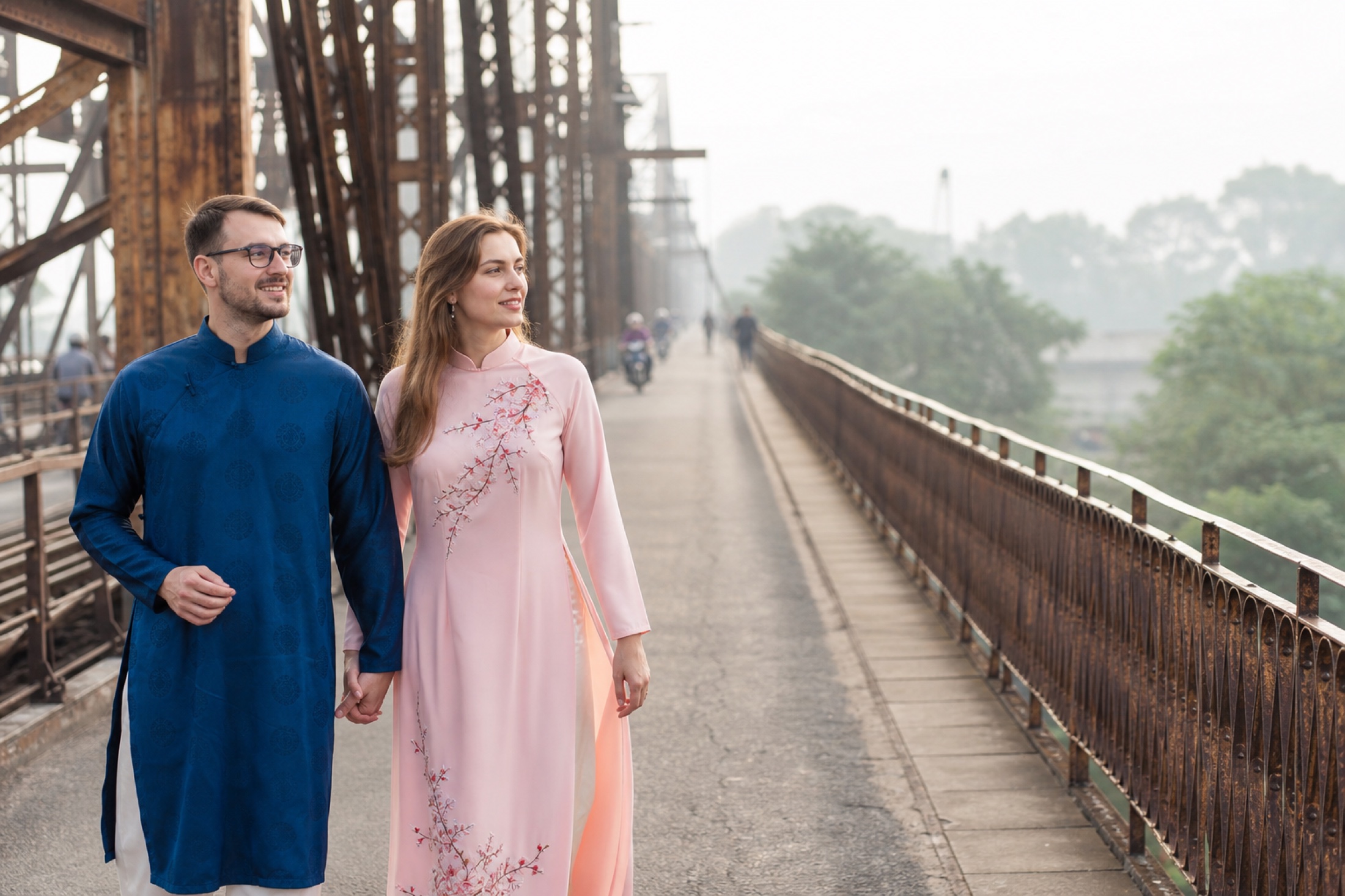
5–6 p.m. (golden hour): Lantern light mixes with sunset. Shadows are long; colors warm. This is when 70% of Hoi An photos happen—also when it's most crowded. You'll share frames with tourists.
6:30–7:30 p.m. (blue hour): Lanterns glow brighter. Sky is deep purple-blue. Fewer crowds. Light drops fast, so your shutter speed matters.
6–7 a.m. (dawn): Japanese Bridge is quiet. Mist rises off water. Local vendors are setting up. This is the least crowded window, but you need to be ready to move—light changes in 20 minutes.
9 a.m.–4 p.m.: Hard shadows, flat light. Skip unless you're shooting into storefronts for detail work. Many studios and guides close midday anyway.
Pro move: Book a 5–7 p.m. session, not 5–6. You get golden hour and blue hour, and the photographer can pivot if a crowd swells. Studio backup sessions work here—if weather kills outdoor light, shift indoors without losing 2 hours.
What should you actually wear under an ao dai for photos?
This matters more than travelers expect. Ao dai is a two-piece: tunic (front and back, floor-length) plus silk pants. It's floor-length even when you're standing; when you sit, the hemline drapes across your lap. But under it, you need:
| Layer | Why | What to avoid |
|---|---|---|
| Seamless undergarment | Shows zero lines under thin silk | Visible panty lines, bra straps (tunic is backless) |
| Nude or matching slip | Prevents tunic from clinging to legs | Wearing nothing (tunic becomes sheer in sun/flash) |
| Flat shoes for walking | Ao dai hem drags; heels catch fabric | New heels (you'll roll an ankle; rent or break in first) |
| No heavy jewelry | Tunic fabric is delicate silk; weight pulls seams | Dangling earrings (get caught on tunic collar) |
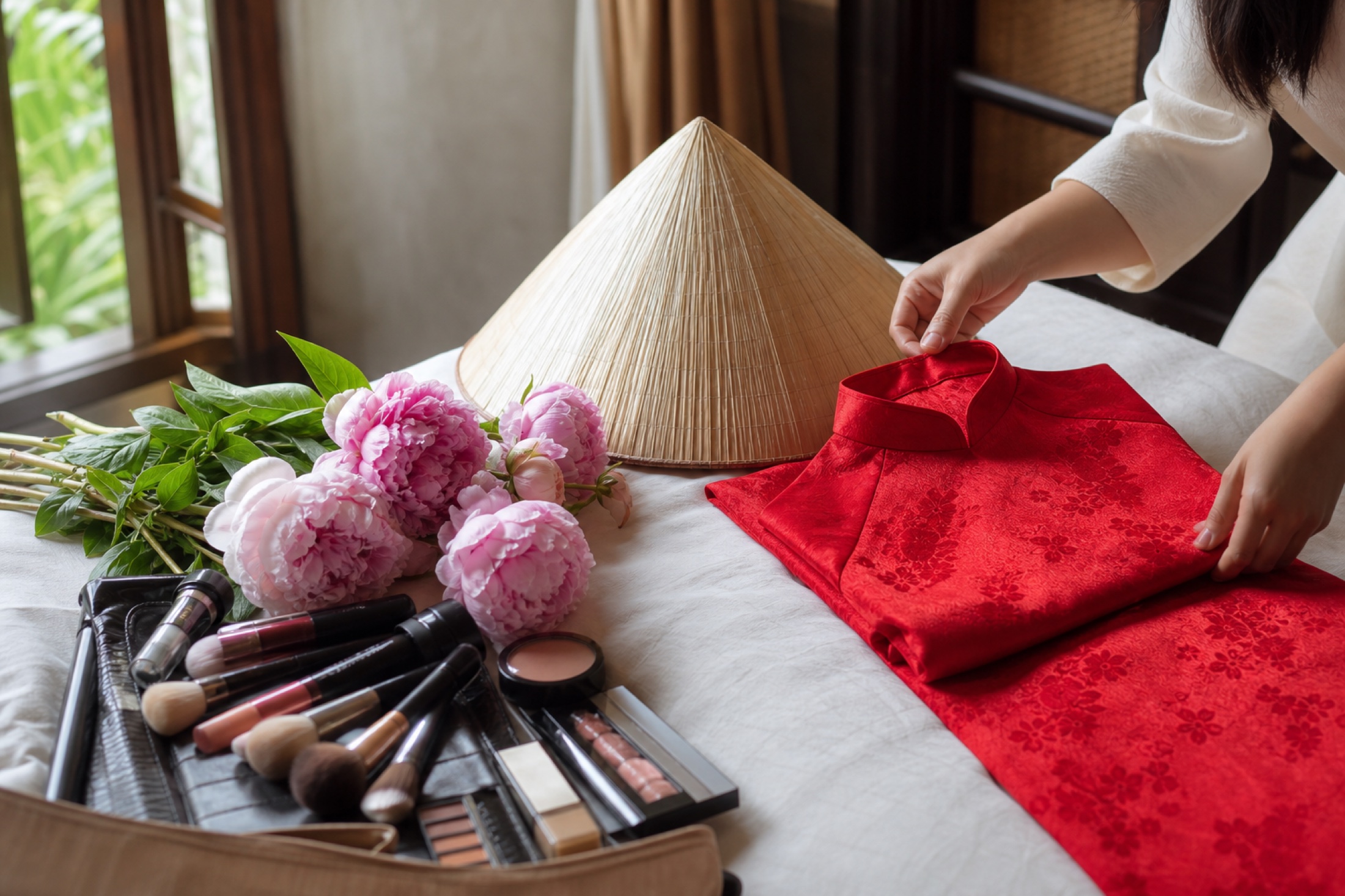
The mistake: Wearing a regular bra under an ao dai. The tunic's back is a single open piece—bra straps are fully visible. Wear a strapless option or go braless if your studio provides fitted tunic sizes (Cáo Studio's ao dai runs XS–XL; confirm fit before the shoot day).
💄 Makeup & hair at your hotel | 📸 Book on WhatsApp — ao dai photoshoot
How do you navigate temple etiquette during a Hoi An photoshoot?
Hoi An's three main temples—Assembly Halls of Fujian, Cantonese, and Hainanese Chinese—are active spiritual spaces, not photo studios. You can shoot outside their courtyards and entrances. Inside requires:
- Remove shoes (or wear easily slippable sandals).
- No climbing or posing on altars. Sit respectfully; stand to the side.
- Bow briefly to any shrine. Takes 3 seconds.
- Ask locals before shooting. A simple "chup anh được không?" (can I take a photo?) opens doors—literally, staff will let you inside quiet hours.
- Skip flash indoors. Temples are dark for atmosphere. Push your camera's ISO or use natural window light.
- No sitting on thresholds. That's where spirits are believed to pass.
Most street photoshoots skip temples entirely—the lanes between them are more photogenic anyway. If your guide or studio includes temple access, you're getting insider knowledge. Cáo Studio's couple & family photoshoot guides know these unwritten rules.
What weather actually ruins a Hoi An session—and what doesn't?
| Condition | Shootable? | Why | Workaround |
|---|---|---|---|
| Light drizzle | Yes | Wet stone = reflections; mood deepens | Bring microfiber cloth for lens; reschedule only if it worsens |
| Heavy rain | No | Ao dai silk gets heavy; you slip on wet alleys | Pivot to studio backdrop session same day |
| 90%+ humidity | Yes | Hoi An is humid; embrace it | Loose hair, matte makeup, microfiber towel in pocket |
| Fog/mist | Yes (best) | Lanterns glow brighter; mystical feel | Book dawn (6–7 a.m.) when mist peaks |
| Heatwave 38°C+ | Risky | Tunic clings; makeup runs in 20 min; you overheat | Shoot before 9 a.m., shorter session, studio with A/C backup |
The real issue: Not weather, but humidity + makeup. Hoi An sits 0.5 km from sea; air is always wet. Waterproof foundation, powder touch-ups every 15 minutes, and a matte setting spray are non-negotiable. Cáo Studio's makeup & hair service uses humidity-tested products; ask for "long-wear, waterproof" when you book.
Best booking window for weather: October–November (cool, dry, clear light). May–September is hot and humid—but mornings are still sharp, and mist sessions in July–August are stunning.
How does a typical Hoi An session actually run?
Before arrival:
- Confirm time, location, and weather backup plan 48 hours ahead via WhatsApp.
- Arrive 15 minutes early; bring water and phone charger.
- If booking with makeup, arrive 30 minutes early (makeup takes 45–60 min).
Street session (1.5 hours):
- Minutes 0–10: Walk the first lane, photographer scouts light and frames you.
- Minutes 10–45: "Golden hour" shooting—most photos happen here. You'll stop at 4–6 preset spots (bridge, lantern shop, riverside).
- Minutes 45–75: Explore together, move if crowds peak. Photographer captures candids.
- Minutes 75–90: Blue hour, final frames, wrap.
Studio session (1–2 hours):
- Minutes 0–20: Makeup touch-up, ao dai fitting.
- Minutes 20–100: Shooting with 3–5 backdrop setups (lantern backdrop, silk curtain, studio floor). You'll change ao dai between setups if booking multiple styles.
- Minutes 100–120: Proofs preview, next steps.
Delivery: Digital files (JPEG + RAW) arrive within 5–7 business days. Studio sessions include 1 free retouching pass; street sessions include color/exposure only.
This timeline is standard across Cáo Studio's Hanoi and Saigon branches; see full details on the lookbook.
What should you check before booking a Hoi An photoshoot?
1. Session type confirmation
- Are you shooting street, studio, or both?
- Does your booking include a guide, or are you self-guided with a photographer on standby?
- Is location scouting included, or do you choose spots?
2. Ao dai provision
- Does the studio provide ao dai, or do you bring your own?
- What sizes are available? (Check against your measurements, not guess.)
- Can you do a fitting 24 hours before, or is it shoot-day only?
3. Weather pivot plan
- If rain cancels, do you reschedule free, or pay a rebook fee?
- Can you move to studio same-day without penalty?
- Is the policy in writing before you pay?
4. Makeup included?
- Street sessions typically don't include makeup.
- Studio sessions may include or charge separately.
- If you have sensitive skin or allergies, does the studio provide hypoallergenic options? (Ask before booking.)
5. File rights
- Do you get full-resolution files, or compressed web versions only?
- Can you print commercially, or personal use only?
- Are RAW files included, or JPEG only?
6. Group size limits
- Hoi An streets are tight. Groups 4+ need guides who know crowd management.
- Studio sessions charge per-person or per-hour?
📸 Book on WhatsApp — ao dai photoshoot
Book through Cáo Studio's WhatsApp line; staff confirm all 6 points in writing before payment. See pricing & package details.
What's the honest comparison: Hoi An shoot vs. Hanoi or Saigon?
Hoi An offers unmatched texture—lanterns, river, weathered wood, zero modern architecture in the frame. But it's also:
- Tourist-dense (especially 5–6 p.m.).
- Limited studio backdrop variety.
- Heat and humidity year-round.
- No option to "go local"—you are the tourist.
Hanoi shoots (Cáo Studio Hanoi) give you French colonial architecture, lake reflections, and quieter temples. Saigon (Cáo Studio Saigon) has modern backdrops and rooftop light. Choose Hoi An specifically for: authentic Southeast Asian mood, lantern aesthetics, and couple sessions where place matters as much as portraits.
For pre-wedding shoots, Hoi An works best as a half-day add-on, not the main session—you'll want time in multiple locations. Cáo Studio combines Hoi An with nearby Da Nang beaches for 2-day packages; ask during booking.
---
Real-world tip: What actually goes wrong, and how to avoid it.
Mistake top: Booking peak golden hour without a crowd buffer. Solution: book 5–7 p.m., not 5–6 p.m. You get both golden and blue hour, and can pivot if tourists swarm your preset spots.
Mistake #2: Renting an ao dai on shoot day. Solution: Pick up or fit 24 hours before. Rushed fittings lead to tunic drags, visible panty lines, and unflattering hemlines in photos.
Mistake #3: Wearing a regular bra under an ao dai. Solution: Go strapless, braless (if fitted), or ask the studio to provide a backless top option. It's one outfit—plan for it.
Mistake #4: Showing up without weather backup. Solution: Confirm rain pivot with studio before you book. "We'll move to studio same-day" is different from "Reschedule in 2 weeks."
Mistake #5: Not asking what "includes makeup" means. Solution: Clarify—makeup can mean "full face," "touch-up only," or "your cost separately." Ask for product list if you have sensitivities.
Go to the full lookbook for session samples & real client stories.
FAQ
Is a Hoi An photoshoot worth it if I'm only there 1 day?
Yes, if you book early morning (6–7 a.m., 90 minutes). You capture mist, avoid crowds, and have time to explore temples after. Studio-only sessions work if time is tight. Don't rush golden hour—bad light + rushed shots = regret.
Do I need to speak Vietnamese to book a Hoi An photoshoot?
No. Cáo Studio handles bookings in English via WhatsApp. Bring a simple phrasebook ("beautiful," "stop," "one more") for shoot day if your photographer isn't fluent English-speaking—most aren't, but they work by direction and mood, not words.
Can I wear my own ao dai instead of renting?
Yes. Bring it in carry-on (wrinkles = steamer on arrival). If it's vintage or delicate, warn the studio—some won't shoot in high-risk fabrics. Studio-provided ao dai are insured; yours aren't.
What if I hate my Hoi An photos?
Cáo Studio offers 1 free retouching pass (color, exposure, minor blemishes). Major reshoots require a new session booking. This is why confirming the photographer and editing style before you book matters—not after.
Is blue hour (6:30–7:30 p.m.) actually better than golden hour?
For lanterns, yes. For skin tone and detail, golden hour wins. Best: shoot both. You'll get variety without rushing either—this is why 5–7 p.m. slots are worth the cost premium.
How much does a typical Hoi An photoshoot cost?
Pricing varies by session type, ao dai rental, and location (studio vs. street guide). Get a custom quote via WhatsApp; no upfront fees or hidden charges.
FAQ
Is a Hoi An photoshoot worth it if I'm only there 1 day?
Yes, if you book early morning (6–7 a.m., 90 minutes). You capture mist, avoid crowds, and have time to explore temples after. Studio-only sessions work if time is tight. Don't rush golden hour—bad light + rushed shots = regret.
Do I need to speak Vietnamese to book a Hoi An photoshoot?
No. Cáo Studio handles bookings in English via WhatsApp. Bring a simple phrasebook ("beautiful," "stop," "one more") for shoot day if your photographer isn't fluent English-speaking—most aren't, but they work by direction and mood, not words.
Can I wear my own ao dai instead of renting?
Yes. Bring it in carry-on (wrinkles = steamer on arrival). If it's vintage or delicate, warn the studio—some won't shoot in high-risk fabrics. Studio-provided ao dai are insured; yours aren't.
What if I hate my Hoi An photos?
Cáo Studio offers 1 free retouching pass (color, exposure, minor blemishes). Major reshoots require a new session booking. This is why confirming the photographer and editing style *before* you book matters—not after.
Is blue hour (6:30–7:30 p.m.) actually better than golden hour?
For lanterns, yes. For skin tone and detail, golden hour wins. Best: shoot both. You'll get variety without rushing either—this is why 5–7 p.m. slots are worth the cost premium.
How much does a typical Hoi An photoshoot cost?
Pricing varies by session type, ao dai rental, and location (studio vs. street guide). [Get a custom quote via WhatsApp](/book); no upfront fees or hidden charges.
Ao dai, makeup, hair and a local photographer in Hanoi or Saigon — one WhatsApp message.